

Dr. Ashish Kumar, K14338,
Dr.Srinivasan M
Dr. Ashish Kumar, DNB, Dr. M. Srinivasan, MD,
Introduction:
Eyes are one of the most important sensory organs in the human body because it renders vision and the power to see. Visually impaired people feel that their life is incomplete as they can just touch, feel and smell things but can’t see it. Eye donation is an act of donating one’s eyes after his/her death. It is an act of charity, purely for the benefit of the society and is totally voluntary. The eye donation of the deceased can be authorized by the next of kith & kin even if the deceased did not pledge to donate his / her eyes before death. Age or systemic illness such as diabetes or hypertension, heart disease, kidney disease is not barriers for eye donations. The corneas of a person are unaffected even if they have undergone any eye surgeries in the past and hence will be useful can be transplanted in others. Donated eyes can be used to restore vision in people who are suffering from corneal blindness.From each pair of donated eyes, two blind people will get vision and light in to their life, thus making it more divine.
When we look back in the history of the eye banking productivity in India; it has not changed much over the period of time. Still, we are in the need of more corneas to meet the demand and supply. Shortfall is still in India even though we have initiated lot of social awareness program among the community.
Population and death ratio matrix in India:
- We are crossing 124 crore population
- Death ratio in India 4/1000 population
- Calculate the average death in a year : Above 1 crore
- If 1 % of the population comes forward to donate their loved ones eyes, we can meet out the demand and supply within a year.
Voluntary donation and hospital cornea retrieval Program (HCRP) are the major strategies in Indian eye banks for mobilizing the eyes.
Five year statistics of India;
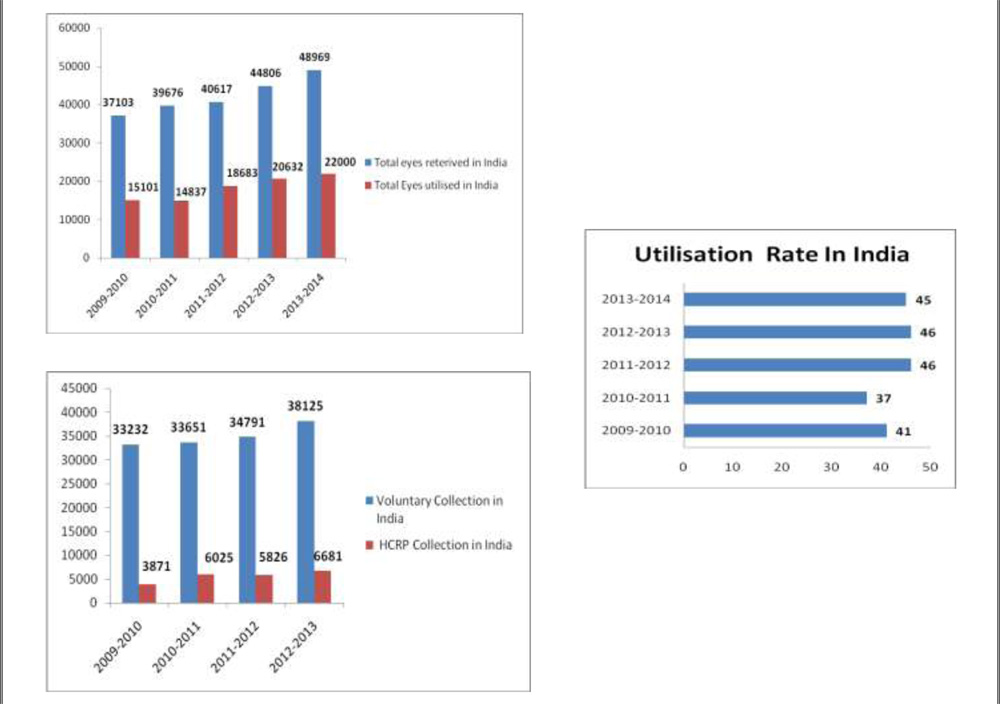
From the above chart, it reveals that we have good potential in the voluntary donation as most of the deaths are happening at home. Hence, there is a massive need to promote lot of new programmes which ensures public participation towards eye donation in India. Such initiatives would help us to clear the backlog of corneal blindness in India.
Rotary Aravind International eye bank (RAIEB) was established in the year 1998 which play a major contributing role in eye banking. RAIEB is pioneer in promoting eye donation in community. 80 % of productivity of RAIEB is depending on the voluntary donation.
Challenges of RAIEB in involving the community towards eye donation:
RAIEB has a good voluntary collection program. It has two sub components under the voluntary collection program
- Voluntary call directly addressed by the Eye Bank
- Voluntary call addressed by the designated eye donation centre or volunteers
Voluntary call directly addressed by the Eye bank:
Here, the volunteers motivate and facilitate the family members to take a decision on eye donation. After acceptance and consent from the family members; immediately the volunteer calls the eye bank for further procedure. After receiving the call from the volunteer, the eye bank personal enquire and collect the required family topography or history and details about the deceased for better screening. If there is no contradiction, the trained team from the eye bank moves to the deceased home and retrieve the eyes and transport the eyes safely to eye bank. Eye Bank addresses the volunteer call up to 40km around the eye banks due to time of travel. Above 40km, the volunteers address the call with the help of local doctors / technicians
Performance:
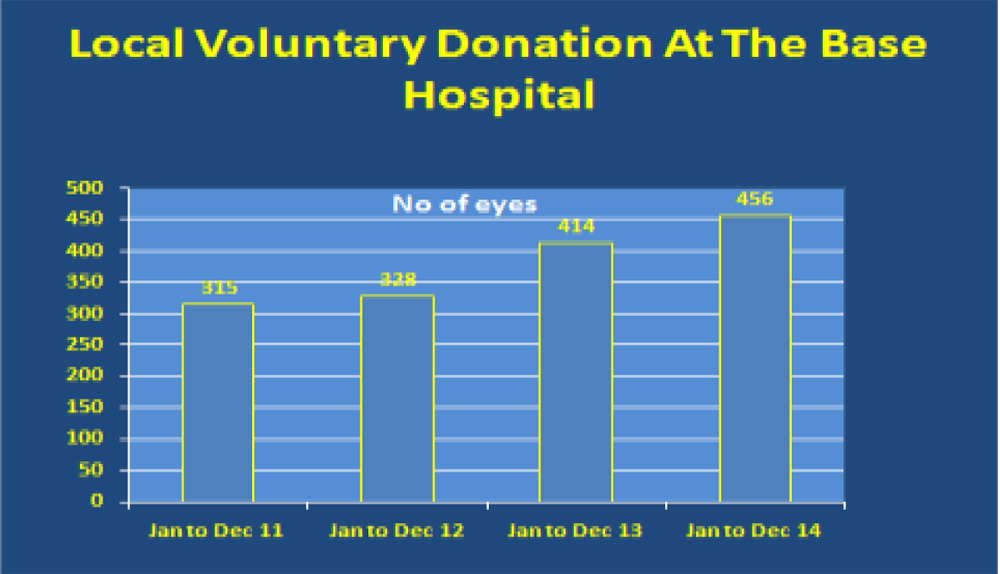
It ensures that there is a considerable improvement in the collection and utilization.
Voluntary call addressed by the designated eye donation centre or volunteers:
After getting the consent from the family members, volunteer calls the local doctors who are trained by eye bank or technician for retrieving the eyes. Volunteer transports the eyes from deceased home to eye bank.
RAIEB observed both collection and utilization have declined from this strategy by 2013 due to various contributing factors.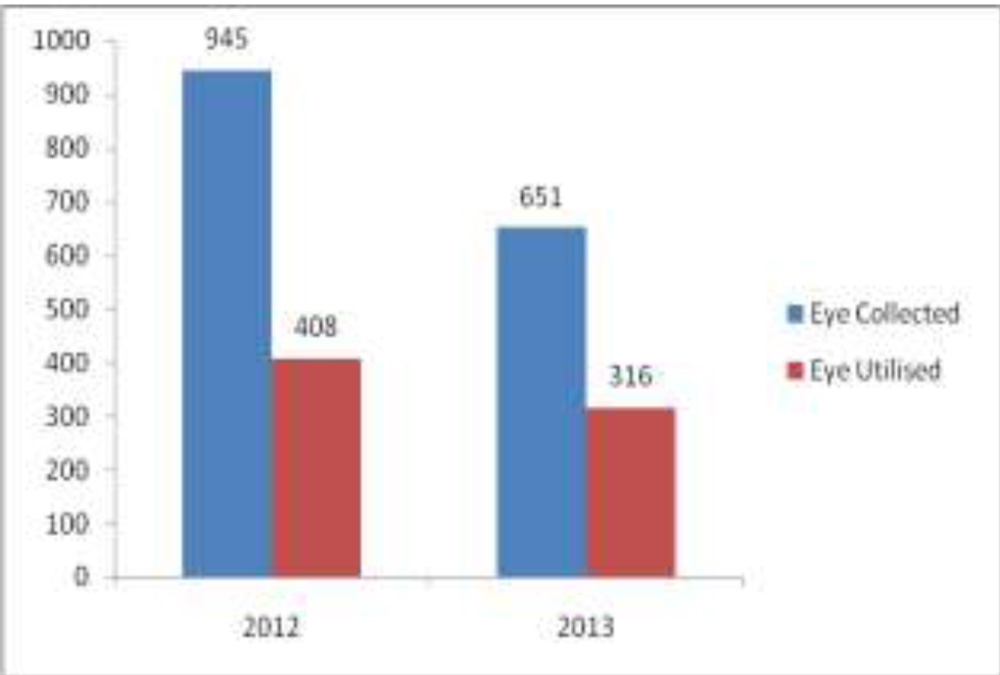
Contributing factors for declining Trends
RAIEB has seriously taken the issues to improve the status of collection and utilization. Hence, the team did a gap analysis with the existing referrers and supporters to understand and analyse the exact situation and tries to locate the problem and influencing factors. Finally, the team found that the following factors really influence the productivity
- Lack of sustained interest among general physicians in harvesting the eyes. Hence, the volunteers were not able to address all the enucleation call in the community.
- Expenditure for harvesting cornea
- Change of President, secretary and treasurer in the lions clubs every year. There is fluctuation in Transformation of eye donation due to the passion towards eye donation differs from each other.
- Transporting the eye balls from collection centre to RAIEB. Packing the tissue as per the protocol and maintaining of the cold between 2C to 8C was questionable.
- Maintaining the quality standards from instrument sterilization to transportation
Need for “A Model “to boost up the scenario:
In considering the problem statement, RAIEB decided to setup the direct center called “Eye Donation Nodal Center. It was decided to set up at Kumbakonam, Tanjore District, Tamilnadu.
Preparing and Involving the existing referrers and supporters to set up the center:
RAIEB had organized a preliminary meeting with existing volunteers & office bearers of the Lion’s clubs. Consequently arranged the brain storming session to understand the issues involved in collection & transportation of eyes among them. During the meeting, RAIEB has sensitized the center activities and role of the referrers and supporters .Then, Joint decision was taken to set up an Aravind eye donation center at the Kumbakonam town. Hence, the first Madurai Aravind Nodal Center was established at Kumbakonam on 24.09.14. The center was inaugurated by Lions Club district governor and local police official. It also gives 40km direct coverage around the center. Hence, most of the potential places are addressed by the center directly. After 50km, the center is encouraging the volunteers to handover the retrieved eyes to the center. Hence, the center is taking the responsibility of proper transportation to eye bank.
Trained staff for the Nodal Center:
RAIEB has appointed two technicians for addressing the enucleation call and one assistant coordinator for developing rapport with community and existing referrers and supporters. The technician has a basic qualification of +2 schooling or above. RAIEB extended the one month intensive training to the technician on all eye bank techniques. After the training, RAIEB posted the technician to the existing local doctors for enucleation. This enlightened the technician to gain knowledge about the practices of the community. Then, technicians are empowered to perform their role independently. Technician’s capacity is periodically reviewed by RAIEB. RAIEB also ensures the learning to all the technicians by giving opportunity to learn from different organizations and eye banks.
Unique Mobile Number for the center:
RAIEB decided to promote a special mobile number for the center. The new number was bought and released by the District collector at Tanjore. The community and volunteer can contact anytime to the center. Now they can directly connect with the center technician for eye donation.
Creating death notification for effectively addressing the enucleation Call:
We have engaged the lions clubs and other supporters for active referral .We have also attended and organized various awareness programs in the community with the active participation of local clubs and supporters. We have involved the district administration for spreading the awareness about the importance of eye donation and functioning of eye donation center. The awareness programmes enhance the community to contact the center very effectively. This gave a good death notification to the center from the volunteer and community.
Extended the 24*7 Coverage:
The center is also extending 24 * 7 coverage for eye donation. It extends effective communication from community to center for effective death notification system.
Sharing of Responsibility:
In the view of shared responsibility and reducing the expenditure and burden to the referrers, RAIEB has taken the expenditure of initial set up cost, man power, rent, electricity charges and all the accessories of the center. The referrers are taking the responsibility of facilitating the consent of eye donation and transportation of the technician for retrieval.
Ensure the quality at all the level:
Trained technicians ensured all the quality standards of RAIEB from receiving eye donation calls to transporting the eyes from center to RAIEB. Hence, RAIEB receives quality tissues with all the needed details for effective processing. Periodical audit has been organized to ensure the quality standards.
Organize Outreach Program with the active involvement of referrers and supporters:
Eye bank team and Asst coordinator of the center periodically contact the referrers and supporters for identifying the growth avenues in their respective area. It was analyzed during the staff review meeting. Then, the plan communicated to the referrers for getting their suggestions for effective implementation. RAIEB also encouraged all the referrers to organize the community outreach program .Scientific sessions of the program is addressed by RAIEB for ensuring the right information delivery to the community. RAIEB involves with all the referrers and volunteers to spread the information about eye donation
Reflection from Model: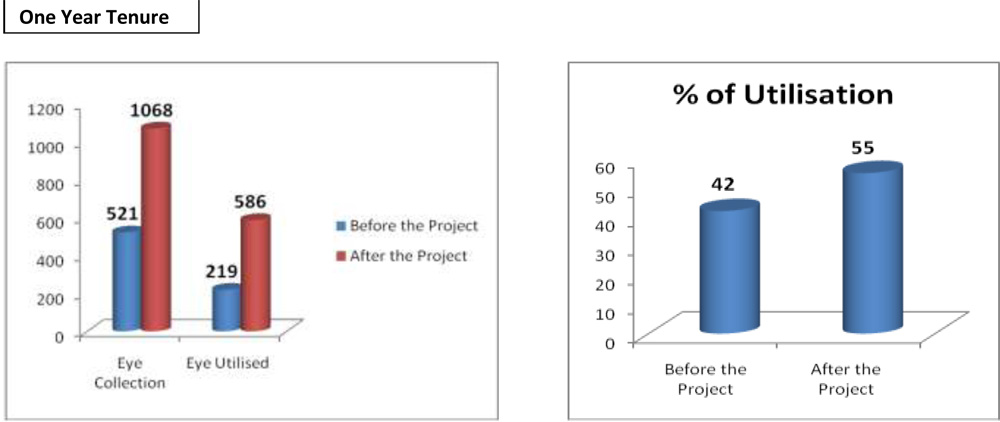
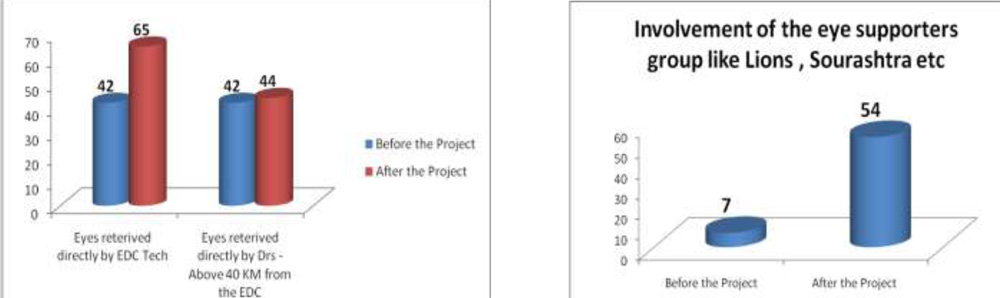
The above chart reflects the productivity of the project. It ensured
- Better Collection
- Better utility of tissue
- Completely filled up eye donation forms
- Retrieval of corneas with the deceased blood
- Ensured the safe transportation
- Increased peoples participation
Conclusion:
Having a base hospital / Eye bank owned eye collection center with a good tie up with local community groups seems to be a workable and effective model .This model was replicated by two Indian eye banks and got success.
According to the potential of India, we can meet the demand and supply of corneal tissues with the active participation of the Community. We should concentrate among the community on promoting awareness, make the community to actively involve the eye donation, finding out more volunteers to bridge the gap between community and service providers , need more qualified service providers and professionals.