

Phacoemulsification using rotating needle – a newer cheaper technique
Dr. Mohammad Abu Yousuf Talukder,
MBBS, DO
Resident Surgeon
Medical College for Women & hospital
Introduction
Cataract is a leading cause of blindness worldwide. Fortunately it is curable. A patient having cataract, his/her visual acuity will be up to hand movement or perception of light and projection of rays, but after cataract surgery visual acuity will be 6/6. From very beginning cataract surgery was not so easy and safe. We had so many bad experiences regarding intra capsular cataract extraction. We have overcome this situation by introducing extra capsular cataract extraction instead of ICCE, to minimize the complications which normally occurred during intra capsular cataract extraction surgery.
Now-a- days, it is further improved to small incision cataract surgery rather than extra capsular cataract extraction. The main improvement behind SICS was that no suture is required where extra capsular cataract extraction required stitches.
Recent advances of cataract surgery is highly sophisticated and give the person early visual outcome, with less or no astigmatism, with no hospital staying, after undergoing cataract surgery. Phaco emulsification is the ultimate choice for new generation due to very small incision cataract surgery called micro incision cataract surgery. Only 2-3 mm or less incision is required and in this case nucleus of lens is emulsified by a titanium needle which vibrates on an average frequency of 28,000 to 40,000 hertz, and Amplitude is 5 -15 micron due to a signal from ultra–sound phaco emulsification machine.
However, this device has some limitations in the context of the poverty and health care in under developed and developing countries, such as Bangladesh.
First of all, it is very expensive. Cost of each machine is 40,000 -50,000 US dollars. Moreover, we need to change cassette, needle etc time to time, prior to surgery. This requires huge financial involvement to complete an operation. So very less number of surgeons in third world country are using this device for cataract operation.
Secondly, it is not used in case of hyper mature cataract due to severe complications like posterior capsular tear , vitreous prolapsed, drop nucleus to vitreous etc. In third world country most of the patient chooses to do cataract surgery at hyper mature stages due to their poverty, ignorance and also negligence. So for that particular patient surgeon choose to do SICS rather then phaco-emulsification surgery.
Thirdly, less number of phaco surgeons are available in third world country due to less number of training centers and trainers, and also long learning curve. Surgeons need very long time to adopt with phaco emulsification surgery.
To make the machine more effective and acceptable to all surgeons, it is proposed to make a device to overcome most of the above limitations, and to make cataract surgery easier for the Surgeons and also safety to the patients.
At the time of experiment, it has been found that the rotating needle is breaking lens nucleus like phaco emulsification machine. There was a special type of needle called Yusuf’s Needle was used where there are 3-4 needles are incorporated with each other giving a special effect.
The cost of device is so low that it can be compared to the cost of cassette of phaco machine which needs to be changed time to time during phaco surgery. Besides this procedure is easy to learn and can be easily applied to rural areas by surgeons. It is believed that this device can be used in all types of cataract surgery without any major complications.
History of phaco
Before the invention of Phaco-emulsification machine, Charles. D. Kelman (The inventor of Phaco machine) had tried to do phaco –emulsification using rotating needle.
He tried a simple rotating device, thinking that if he could drill a tooth, he could drill away a cataract .This only made the lens spin inside the animal’s eye, denuding the endothelium. He then added suction and irrigation, in an attempt to keep the lens from rotating. However, this did not prevent the lens from spinning, so he introduced other instruments in an attempt to hold the lens in place while it was being drilled. This attempt was unsuccessful too. So, he took two needles rotating in opposite directions, similar to a food blender. This approach was exceedingly dangerous, since it set up eddy currents which drew the iris to the needles, causing a complete disinsertion of the iris with hemorrhage
Material and method
New machine is very ordinary but effective. It works by rotating a special type of needle (Yousuf’s needle) containing three to four needles, incorporated with each other, which is connected with a small motor. The said Motor rotates by DC (Direct Current) whose voltage will be 1.5V to 12V, with the rotation rate ranging from 700- 1400 rpm.
The Machine has three parts – namely Body, Tube and Yousuf’s Needle.
Yusuf’s Needle –
- Instead of single needle I have made it by multiple needles to get the following advantages –Easy penetration to the lens fibers. a)Quick cutting lens fibers by increasing cutting surfaces of needle.
b) Arrangements of needles are in such a fashion that cutting surfaces will be outside the circle.
- Diameter of Yousuf’s Needle is little bit higher than the existing phaco tip. So if you consider about cutting lens fibers, then my device has advantages over existing phaco device. Existing device has a sleeve. With this sleeve total diameter of phaco tip is 2 mm which is more than my device. Due to production of very low temperature no need of this sleeve in my device. So with more diameter of needle it will easily enter into the anterior chamber with 2.8 mm clear corneal tunnel.
- Generate very low temperature – less than 2’C during emulsifying lens, due to sharp cutting surface and also move slowly – it generate very low temperature.
See table below.
Table-4: Change of temperature in the lens during the operation in a small container
| Time (s) | Temp of Lens (◦C) |
| 00 | 28.3 |
| 05 | 28.6 |
| 10 | 28.6 |
| 15 | 28.9 |
| 20 | 29.2 |
| 25 | 28.8 |
| 30 | 28.6 |
| 35 | 28.7 |
This data shows that fluctuation of temperature is less than 2’C in a cataractous lens when emulsification done by my device. 29.2’C temperature was produced when lens fibers are denser and 28.3’C when lens density is less.
- Serrated Cutting Surface – This device is worked by a low rotating needle. So I can use serrated cutting surfaces instead of plane cutting surface to enhance its efficacy, although now I am using plane cutting surface and got excellent result in emulsifying lens but there is an opportunity in my hand to increase its efficacy more.
- Conform the needle in lens fibers
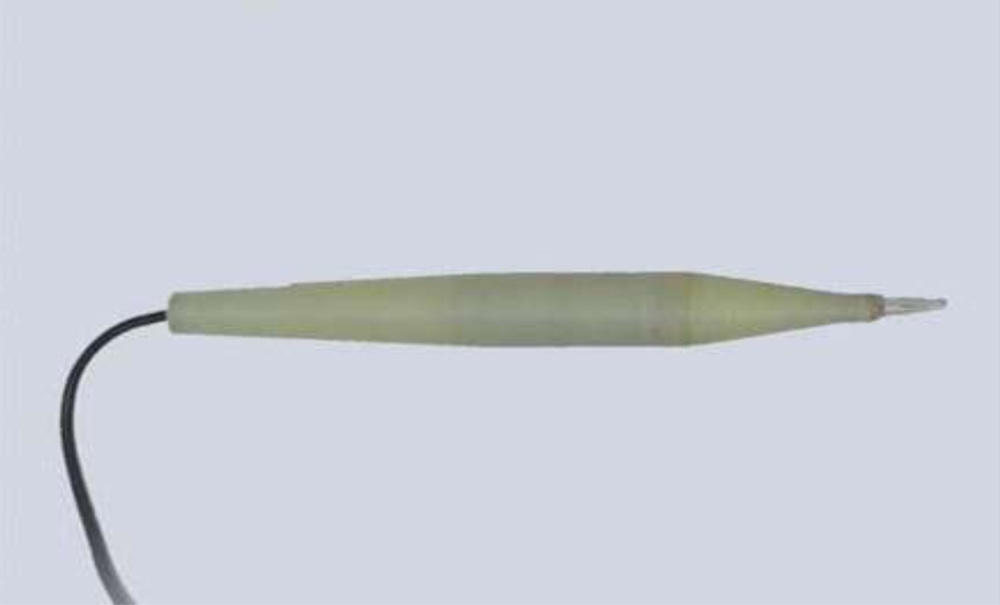
Figure : phaco device using rotating needle
The irrigation and aspiration systems
An irrigation and aspiration system is very much important in case of Phaco emulsification surgery to clear up all the jelly like material which produces due to breaking up the lens matter.
On the basis of irrigation and aspiration systems, this device will be of 3 types.
- This device without irrigation and aspiration system – in that case this device needs only 2 mm clear corneal incision for performing phaco emulsification surgery. There will be no covering of needle (Yousuf’s Needle). In that case we can use two way irrigation and aspiration cannula which we use for SICS (small incision cataract surgery). Obviously here we need 3 incisions. First, for device, secondly for phaco chopper and lastly for two way irrigation and aspiration canola. In that case, surgeon will hold phaco device on his/her right hand and phaco chopper on his/her left hand and assistant will hold two way irrigation and aspiration cannula. So no need a sucker machine for aspiration of jelly like substances. I have used this device for all clinical trials.
- This device with only aspiration system – A modified phaco chopper (irrigating phaco chopper) will be used to hold the lens during emulsification and also irrigation done by connecting this phaco chopper with tube of balanced salt solution. A sucker machine is connected with this device. So, we can easily aspirate jelly like substances by this device. Here incision needs only 2.8mm or below. Only two incisions will be needed, one for the device and other for irrigating phaco chopper.
- This device with irrigation and aspiration systems – in this system, only 2 incisions needed for completing the operation, but the problem is, if we incorporate both irrigation and aspiration systems in a same tube then the diameter of tube containing Yousuf’s Needle will be 3mm or more. On the other hand, surgeon will hold the device on his/her right hand and phaco chopper on his/her left hand so there will be a sucker machine needed to aspirate the emulsifying material .
Methods
The following operational procedures were carried out with the proposed needle-bundle: three different ways; on wood; on goat eye; on human crystalline lens in vitro.
Three different tests have been carried out successfully.
On wood – main idea was that to observe the penetrating capacity, frequency, temperament, fluctuation of the device to get idea of differences between the wood and human crystalline lens.
Experimented on goat’s eye –
Second experiment was carried out with goat’s eye. It is widely practiced to experiment on goat1, sheep2, or pig’s3 eye before going experiment on human eye. Hence, this procedure was experimented on goat’s eye. 50 cases were used for this clinical trial. Method was random but purposive method.
The traditional experiment runs with this device with goat’s eye. After peritomy, we enter into anterior chamber by making scleral tunnel, then doing capsulotomy of anterior lens capsule, hydro dissection, and also hydro deliniation was carried out. Lens was brought to anterior chamber. Then nucleus of lens of goat’s eye was close to this device for emulsification of lens. After rotating of device lens turned into broken particles and afterwards became jelly like substance. Some portion of lens decayed, the process created a hole in the middle of operating portion. Afterwards the broken part of the lens was brought near the needle with the help of a phaco chopper. The device and again started to operate until, the total lens emulsified fully after a period of few minutes at a stretch.
On human crystalline lens in vitro –
After operation of small incision cataract surgery, 50 lenses are collected immediately after delivery of lens and preserved it in visco- elastic substances, and balanced salt solution which is identical to aqueous humor. Lens was held with the lens holding forceps. Then this device started to rotate after penetration through lens. Three different experiments were done, after taking three different types of lenses. First was immature, another was matured and last one was hyper matured cataractous lenses. Method was random but purposive method.
Result
- First experiment was done successfully on the wood. Penetration of this device on wood was free and quick. Wood is a harder substance compared to human crystalline lens, so this experiment showed that easy penetration through human crystalline lens by this device will be possible. Besides this, side to side movement of rotating needle gives the idea about effective phaco emulsification by this device will be
- Second experiment with goat’s eye gives the clear cut idea about the utility of this device. Main idea is tried to evaluate how much efficiency is shown by this device, and also indicate any type of complications do occur or not? Lens of goat’s eye was emulsified successfully with this device repeatedly. No spinning of the lens at all denuding corneal endothelial damage. No severe complication like posterior capsular rupture, vitrious prolaps, no corneal endothelial injury, no wound burn occurred. Initially one minor complication was observed in anterior chamber of goat’s eye, that is iris was injured by the needle but the
problem was overcome by exercising caution.
- With the human crystalline lens we observed
Three different results as follows.
- When experiment was carried out on immature lens, then it turned that the lenses into jelly like substances very quickly.
- When the process was applied to matured lens it has turned into jelly like substances. The procedure was in accordance with the expected rate. That is to say that the lenses have been emulsified optimally as expected.
- However, in case of hyper mature cataract, the process was time prolonged accordance with the expected rate and the lens was jelly like substance.
Production of temperature
This device produces very negligible temperature during emulsifying lens material.
See table below
Table-1: Change of temperature in the lens and surrounding water during emulsification of lens in a
container.
| Time (s) | Temp. of Water (◦C) | Temp of Lens (◦C) |
| 00 | 28.2 | 29.5 |
| 10 | 27.9 | 29.1 |
| 20 | 27.9 | 28.2 |
| 30 | 27.8 | 28.1 |
| 40 | 27.7 | 28.1 |
| 50 | 27.7 | 28.1 |
| 1:00 | 27.6 | 28.0 |
| 1:10 | 27.6 | 27.8 |
| 1:20 | 27.6 | 27.9 |
| 1:30 | 27.6 | 28.8 |
| 1:40 | 27.8 | 27.9 |
| 1:50 | 27.9 | 28.0 |
| 2:00 | 27.8 | 28.2 |
| 2:10 | 27.8 | 28.1 |
| 2:20 | 27.8 | 28.2 |
| 2:30 | 27.8 | 28.2 |
| 2:40 | 27.7 | 28.1 |
| 2:50 | 27.9 | 28.4 |
| 3:00 | 28.1 | 30.6 |
| 3:10 | 28.2 | 28.8 |
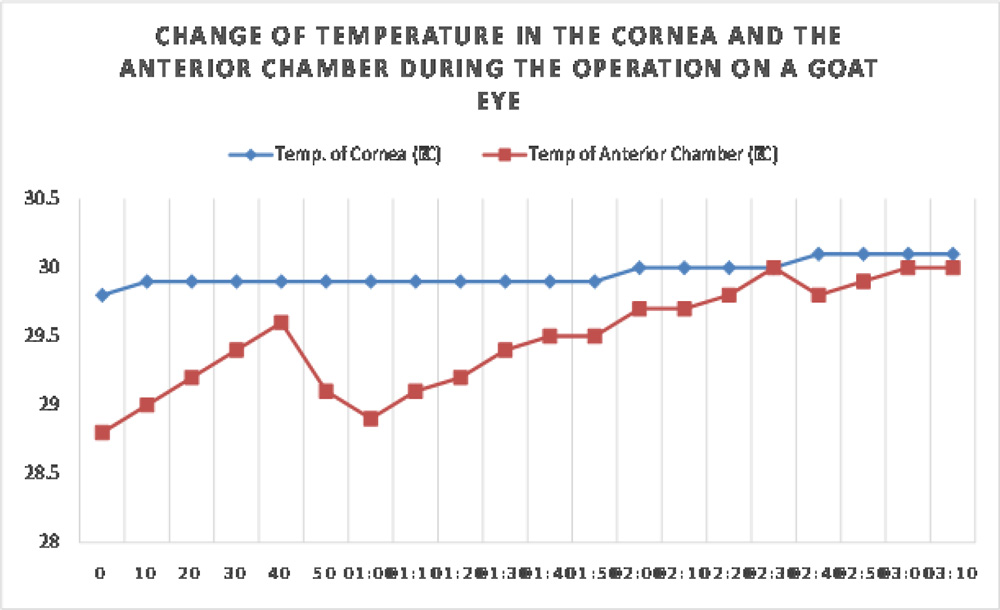
Table-2: Change of temperature in the lens during the operation in a small container
| Time (s) | Temp of Lens (◦C) |
| 00 | 29.7 |
| 05 | 29.6 |
| 10 | 29 |
| 15 | 29.1 |
| 20 | 29.9 |
| 25 | 27.9 |
| 30 | 29.1 |
| 35 | 29.1 |
| 40 | 29.2 |
| 45 | 29.2 |
| 50 | 29.2 |
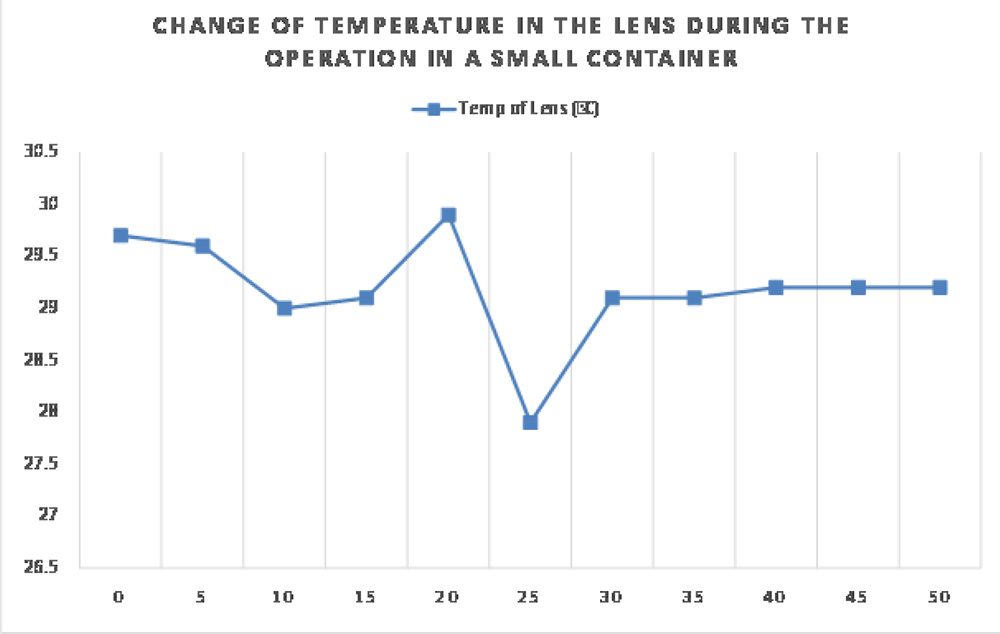
Table-3: Change of temperature in the cornea and the anterior chamber during the operation on a goat eye
| Time (s) | Temp. of Cornea (◦C) | Temp of Anterior Chamber (◦C) |
| 00 | 29.8 | 28.8 |
| 10 | 29.9 | 29.0 |
| 20 | 29.9 | 29.2 |
| 30 | 29.9 | 29.4 |
| 40 | 29.9 | 29.6 |
| 50 | 29.9 | 29.1 |
| 1:00 | 29.9 | 28.9 |
| 1:10 | 29.9 | 29.1 |
| 1:20 | 29.9 | 29.2 |
| 1:30 | 29.9 | 29.4 |
| 1:40 | 29.9 | 29.5 |
| 1:50 | 29.9 | 29.5 |
| 2:00 | 30.0 | 29.7 |
| 2:10 | 30.0 | 29.7 |
| 2:20 | 30.0 | 29.8 |
| 2:30 | 30.0 | 30.0 |
| 2:40 | 30.1 | 29.8 |
| 2:50 | 30.1 | 29.9 |
| 3:00 | 30.1 | 30.0 |
| 3:10 | 30.1 | 30.0 |
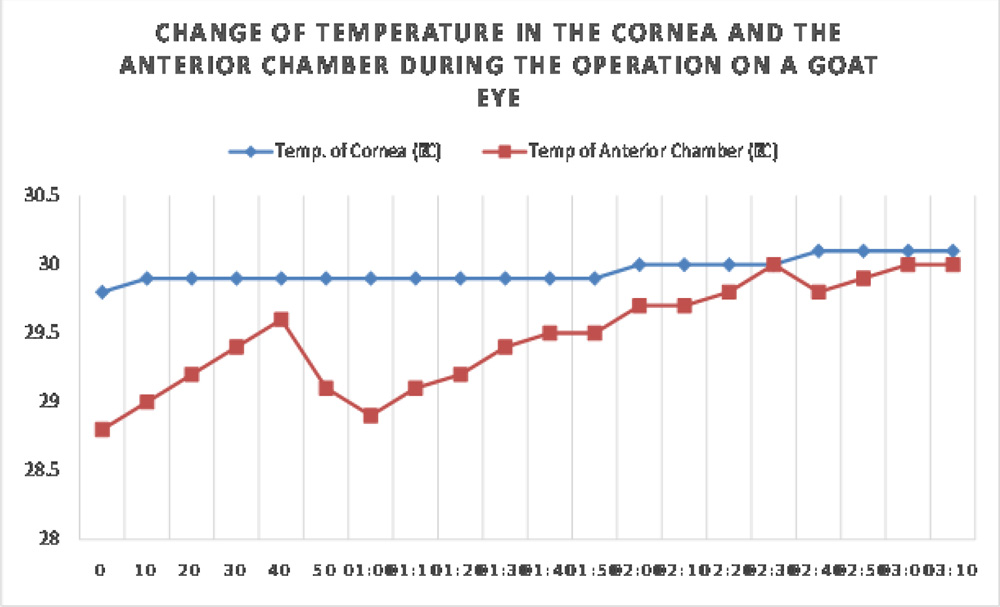
This data shows that very minimum change of temperatures i.e. very low Cumulative Disperse Energy (CDE) occurred when operation done by this device on both human and goat’s eye. Note that fluctuation of temperature depends on density of lens, duration of procedures and distance of eye structures
Conclusion
Phaco emulsification surgery for cataractous lens extraction is latest technique accepted worldwide where a titanium needle is vibrate with high frequency i.e. 28,000 to 40,000 hertz, vibrating spike is 6 to 15 micron by means of ultrasound. This device is very effective for extraction of cataractous lens , but the problem is this instrument is not a simple machine, during operation so any problem arise like changes of temperature, changes of pressure changes of vacuum etc so if surgeon is not skilled enough he may mistake causing serious vision threatening problem for patient.
But my device is a simple device; no raise much temperature to cause thermal injury to surrounding structure during operation. Efficacy is almost same to phaco machine. I have used mechanical energy to rotate a needle which will emulsify lens material successfully and lens fibers will be converted into a jelly like substances and then it will evacuated by two way irrigation aspiration cannula. So, by using my proposed device we want to decrease severe complications during surgery which will be cost effective as well. The basic mechanism of new device is different than phaco machine. Proposed device will work by rotating a special type of needle (Yousuf’s needle) at the rate of less than 2,000 rpm where phaco machine works by vibrating a needle which is made of titanium. This low rotation can be achieved by using a ‘DC’ motor where voltage will be between1.5 to12 volt.
Reference:
- Dada VK1, Sindhu N.Cataract in enucleated goat eyes: training model for phacoemulsification.J Cataract Refract Surg. 200Aug;26(8):1114-6.
- 2.Mohammadi SF, Mazouri A, Jabbarvand M, Rahman-A N, Mohammadi A. Sheep practice eye for ophthalmic surgery training in skills laboratory. J Cataract Refract Surg 2011; 37:987–991
- Van Vreeswijk, Pameyer JH. Inducing cataract in postmortem pig eyes for cataract surgery training purposes. J Cataract Refract Surg 1998; 24:17–18 4.
- Sudan R, Titiyal JS, Rai H, Chandra P.J Cataract Refract Surg. 2002 Nov;28(11):1904-6.PMID:12457661[PubMed – indexed for MEDLINE]