Dr. Karthikeya R ( K19483 ), Dr. Shorya Vardhan Azad, Dr. Raj Vardhan Azad, Dr.Ruchir Tewari, Dr. Karthikeya R
Posterior segment nucleotomy for dislocated scleroticcataractous lens using chandelier endoilluminator andsharp tipped chopper.
INTRODUCTION
Posteriorly dislocated cataractous lens is a potentially devastating complication of phacoemulsification, wellmanaged with conventional vitrectomy systems [1]. Withadvances and introduction of surgical adjuncts [2], the surgeryhas improved and is simplified. While newer techniquescontinue to emerge [3,4], surgeons may encounter dislocatedlarge mature nuclei that are difficult to fragment into smallerpieces using the standard 3 port vitrectomy. Infact surgeonscontinue to consider levitating and delivering hard fragmentsthrough the anterior route. We introduce a simple techniqueusing chandelier endoilluminator (CE), fragmatome andchopper to overcome such a situation safely and easily.
SUBJECTS AND METHODS
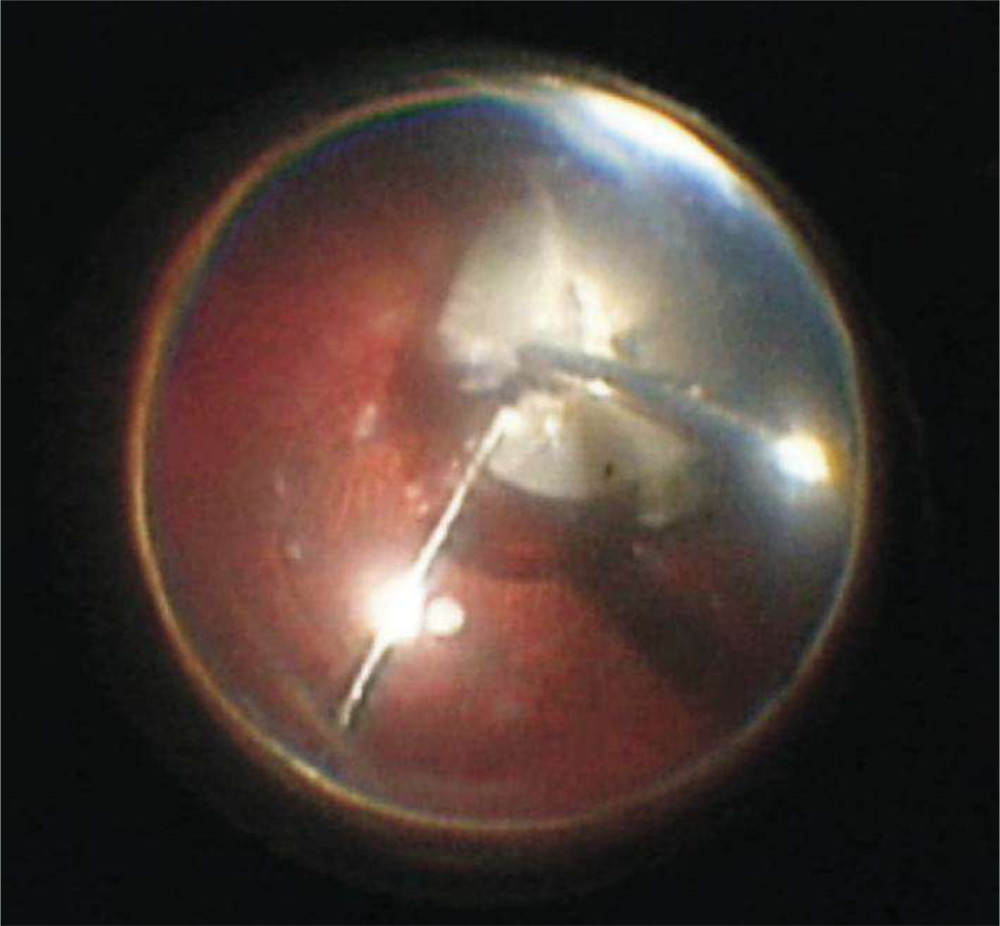
Sixsurgeries were performed with the new technique over a period of 6 months and then retrospectively reviewed (Table 1).Surgeries were done by a single surgeon. Four patients werepseudophakic, referred from peripheral centers and operated as a secondary procedure while 2 were aphakic and operatedimmediately at the time of complication. All the patientswere documented to have advanced cataracts preoperatively.All study procedures adhered to the Declaration of Helsinki.Institutional review Board approval was taken. A minimumof 6months follow up was done in all the cases.During the surgery, 3 standard 23 G ports were made for parsplana vitrectomy. After aspirating residual cortical matter inthe anterior segment as required, limited central vitrectomywas done and triamcinolone assisted posterior hyaloiddissection was performed. Then peripheral vitrectomy wascompleted in all the quadrants, with scleral depression asnecessary. Retinal breaks when detected were lasered. Perfluorocarbon liquid (PFCL) was injected at the posteriorpole thereby causing the nucleus to float upon the bubble. A25 G port was then made in the infero nasal quadrant and aCE introduced through it. One superior port was enlargedwith a micro vitreoretinal knife blade for thephacofragmatome while the cannula of the other superiorport was removed to allow the entry of a sharp chopperwithout enlarging the port. Using suction and ultrasonicenergy the nucleus was safely gripped and held withocclusion before prolapsing it to the midvitreous cavity,where the second instrument, sharp chopper, was used toperform a nucleotomy and divide the nucleus into 2 halves(Figure 1). One half fell back on to the PFCL bubble whilethe other half still engaged in the probes’ grip was then againchopped. All these small nuclear fragments were thenemulsified one by one, re chopping/feeding pieces into thefragmatome with the chopper as and when necessary. ThePFCL bubble was aspirated and residual cortical matterremoved with the vitrectomy cutter. Fluid air exchange wasperformed, port sites indented for ruling out retinal breaksand ports closed. Routine post operative care was prescribed.
RESULTS
Mean age of the patients was 70years and all were females. In allthe six cases, the operative settings and the procedure weresimilar. Best corrected visual acuity (BCVA) better than 6/12 was achieved in all the patients at 1 month of follow-up.One case operated immediately after lens dislocation had 2 retinal breaks formed at the time of posterior vitreousdissection during the surgery which were lasered. Otherwiseno significant complication was noted intra operatively or at6month of follow up.
DISCUSSION
Hard nuclei are difficult to chop as protein distribution isdense [5]. Fragmenting such nuclei using the hand heldilluminator is difficult and anecdotally such dislocated nucleihave been delivered through limbal route (sometimes evenrequiring IOL explantation). Phacoemulsification is itselfrelated to thermal injury [6], and due to the higher ultrasonicenergy involved in such sclerotic cases there is always atheoretical risk of sclerotomy site dehiscence.Decision to perform nucleotomy was taken in view of theadvanced cataract noted pre-operatively. Endoilluminationwith chandelier allows usage of a second instrument, achopper, for performing nucleotomy and making the smallerfragments more amenable to emulsification in lesser time.
The sharp tip of the chopper allows for quicker and morecontrolled division of the nucleus. Due to the rapidnucleotomy, ultrasonic power applied appears to be less aswell as for reduced duration hence causing minimal thermaldamage to scleral port. The complication of retinal breaks in 1 case operated immediately at the time of nucleus drop wasrelated to posterior vitreous dissection rather than the newtechnique and occurred before introduction of the CE. Thistechnique is safe for both immediate and delayedfragmentation of nucleus and there is no difference inoutcomes, visual or anatomical. It may however be morehelpful in cases being operated immediately after nucleusdrop where quicker surgery is needed in view of risk of intraoperative stromal corneal edema. We have achieved goodfunctional and anatomical outcomes in twelve cases and theprocedure appears to be free of complications with a favorable learning curve. The present study has been published.[7]
CONCLUSION
Four port posterior segment nucleotomy using a CE andchopper appears to be a safe, easy and effective procedure formanaging dislocated sclerotic cataractous nuclei. Ultrasonicenergy used and adverse thermal effects of the fragmatomeon the sclera may be lesser.
REFERENCES
1) Modi YS, Epstein A, Smiddy WE, Murray TG, Feuer W, Flynn HW Jr.Retained lens fragments after cataract surgery: outcomes of same-dayversus later pars plana vitrectomy. 2013;156(3):454-459.
2) Chiquet C, Thuret G. Perfluorocarbon liquids and vitreoretinal surgery in 2011. 2011;34(9):663-677.
3) Dalma-Weiszhausz J, Franco-Cardenas V, Dalma A. A modifiedtechnique for extracting a dislocated lens with perfluorocarbon liquids andviscoelastics. 2010;41(5):572-574.
4) Nakasato H, Uemoto R, Kawagoe T, Okada E, Mizuki N. Immediateremoval of posteriorly dislocated lens fragments through sclerocornealincision during cataract surgery. 2012;96(8):1058-1062.
5) Krasnov MM, Makarov IA, Said NaimIussef. Densitometric analysis ofcrystalline lens nucleus in the choice of strategy of surgical treatment ofcataracts. 2000;116(4):6-8.
6) Ernest P, Rhem M, McDermott M, Lavery K, Sensoli A.Phacoemulsification conditions resulting in thermal wound injury.2001;27(11):1829-1839.
7) Takkar B, Azad R, Azad S, Rathi A. Posterior segment nucleotomy fordislocated sclerotic cataractous lens using chandelier endoilluminatorand sharp tipped chopper. 2015;8(4):833-834.
Figure 1