

Dr. Pooja Banidvadekar, B15028, Dr. Amrita Ajani
Residency training shapes clinical skills, theoretical knowledge and research aptitude of post-graduate students and lays the foundation of their future practice patterns. Ideal residency training should have an appropriate balance of didactic teaching, clinical knowledge, surgical skills and research training. While most teaching institutes concentrate on the first three aspects in variable amount, an experience of research methodology is limited mostly to writing thesis. The exposure of a student to the process of scientific writing, research methodology and peer review is of paramount importance to understand evidence-based medicine, continue the process of medical education and implement appropriate updated treatment protocols. Hence, we decided to quantify peer-reviewed research output of teaching institutes in India, in the field of ophthalmology.
Methods
This is an Internet based study. The study compiled the number of peer-reviewed papers listed on Pubmed over a period of 4 years from 2012 to 2015. The list of MCI recognized institutes imparting MD or MS degree in Ophthalmology were obtained from MCI website http://www.mciindia.org. Only MCI recognized courses were included. MCI permitted courses were not included in the study. Theses institutes were further classified as government or trust/ private institutes based on the management. The list of institutes allotted DNB candidates was obtained from the annual prospectus published for that particular year. Individual websites of the institutes were accessed and the names and their spellings were checked.
A Pubmed search was carried out for list of publications. The Advance Search feature of Pubmed was used. The name of the institute was searched by affiliation option. Department of ophthalmology was also entered as an affiliation for institutes which had multiple specialties. AND was used as the search criteria. For institutes, which functioned solely as ophthalmology institutes, department of ophthalmology, was not included in the search criteria. When an institute had multiple nomenclatures, spelling variants or abbreviations, OR was used in the search criteria. For example All India Institute of Medical Science was also searched as AIIMS, Dr. Rajendra Prasad Center for Opthalmic Sciences, Dr. R. P. Center for Opthalmic Sciences with and without punctuation marks in between. All entries were saved in separate folders in Zotero to eliminate duplicates. Zotero is anopen source citation managing software.
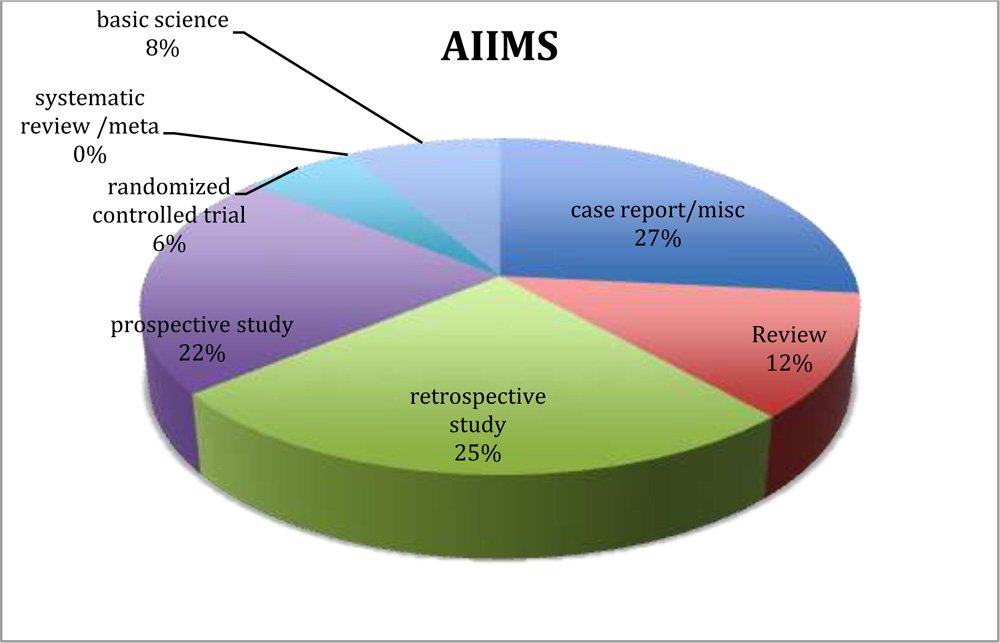
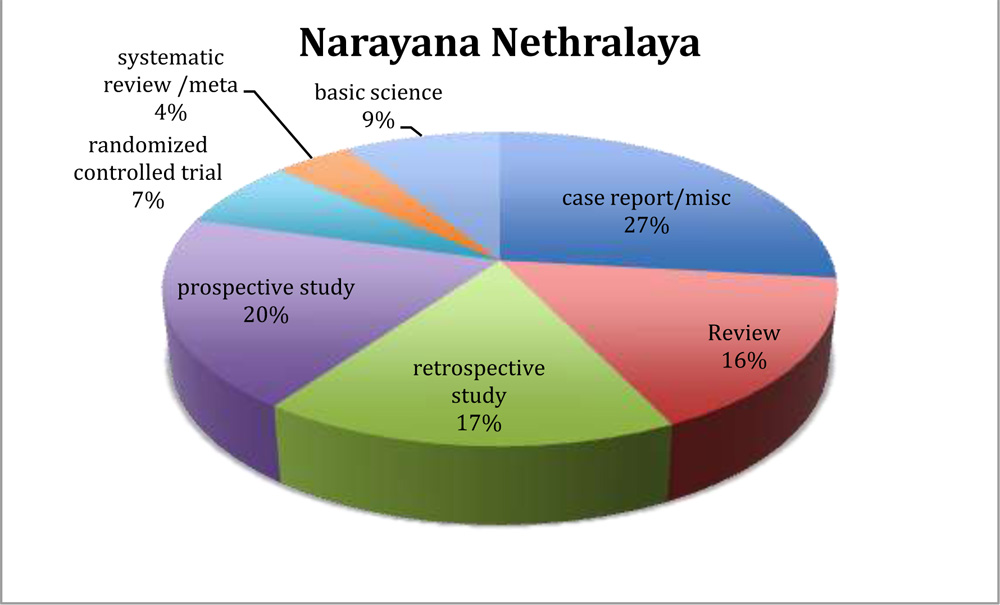
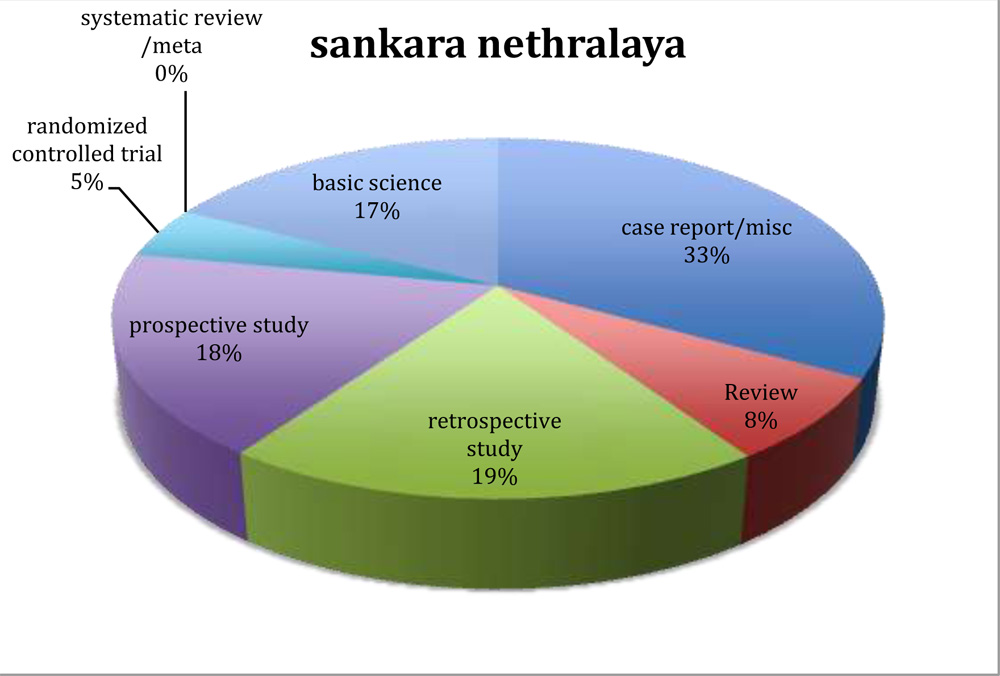
Abstract summary was checked in the display box. Based on the abstract, each study was categorized under one of the six heads respecting the pyramid of evidence. Case reports, editorials, letter to editor, queries were clubbed together. Retrospective study was the second category. Prospective studies (other than Randomized Controlled Trials, RCT) were third category. RCT was categorized separately. Review articles were in a separate category. Systematic review/meta-analysis was a separate category. Basic and translational science articles were classified together in a separate category.
In order to evaluate the productivity of each institute vis-a-vis the average performance across India, the publications per year for each institute was compared with the national average. Thus, if Piwere to be the average publications per year for a particular institute i and P0 – the national average of Pi, the normalized publication performance (NPP) would be given by following formula that has been described previously [NPP= {Pi-Po}/Po].
Results
A total of 889 residency spots were available in 236 institutes in India, in the field of Ophthalmology at an average of 3.78± 3.2 residents per institute. Of these, 133 institutes were managed by private trusts and 102 were government institutes. 177 institutes offered MS/MD degree and remaining 59 institutes were affiliated with DNB board.
Of the 236 institutes, 160 (more than half) institutes had no Pubmed indexed publication between 2012 and 2015. 66 institutes had less than 10 indexed publications in the specified tenure. Only 10 institutes had more than 10 publications over 4 years. Only 6 institutes had > 50 publications over 4 years. The average number of publications per year, per institute was 1.84± 12.46. The normalized publication performance was > 0 for only 12 institutes. The table below describes the publication performance of top 6 institutes.
| Total publications (2012-2015) | Average annual publications | Normalized Publication performance | |
| LVPEI | 647 | 161.75 | 86.90 |
| SankaraNethralaya | 296 | 74 | 39.22 |
| Aravind Eye | 195 | 48.75 | 25.49 |
| AIIMS | 169 | 42.25 | 21.96 |
| NarayanaNethralaya | 113 | 28.5 | 14.35 |
| PGIMER, Chandigarh | 84 | 21 | 10.41 |

CONCLUSION
A large number of medical colleges have minimal to no indexed publications in the recent past. There is clustering of publications in the top 6 institutes, which account for 90% of the output. A rethinking of policy to encourage research work amongst all teaching institutes is the need of the our.