

Dr. Kousik Sarkar, S18651, Dr. Bharat Sarmah Puzari, Dr. Jawahar Jyoti Kuli
Presenting Author : Dr. KousikSarkar
Co-Author : Dr. BharatiSarmahPuzari
INTRODUCTION
Myopia is a form of refractive error wherein parallel rays of light coming from infinity, come to a focus in front of sentient layer of the retina when the eye is at rest.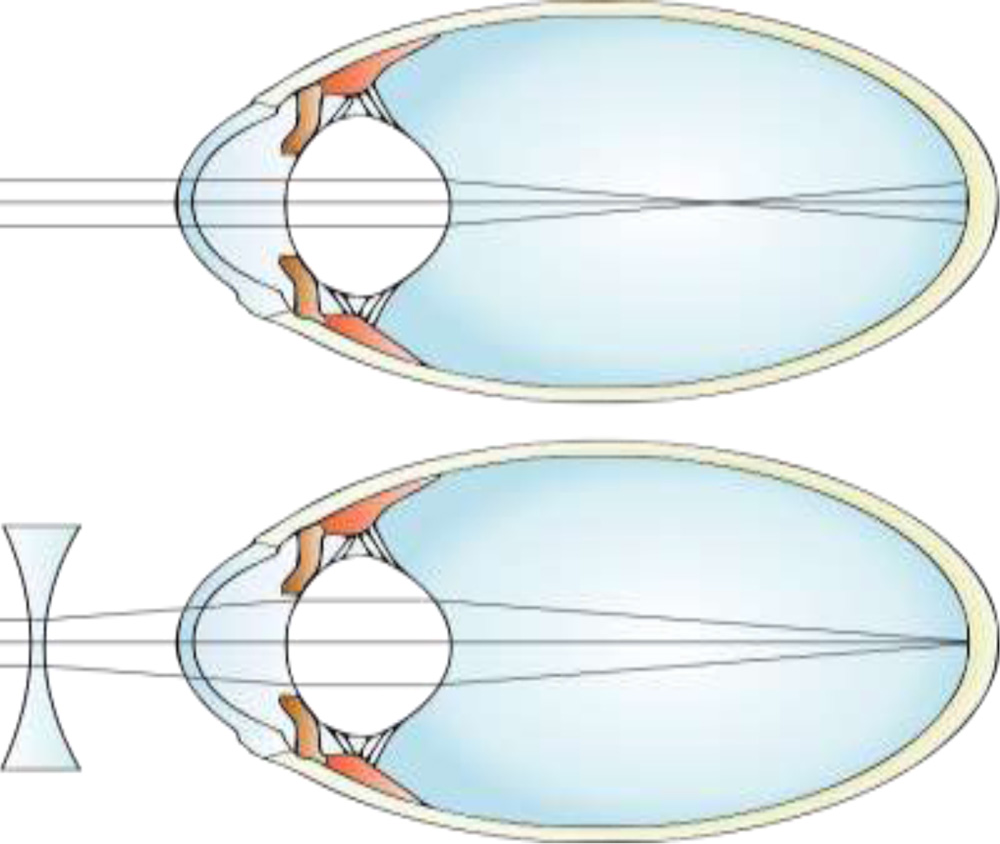
It occurs when the refractive power of the eye is too great compared to the length of the eyeball and this may occur because the eye has a greater refractive power, a longer axial length or a combination of both.
The axial length (AL) of the eye is the distance between the anterior surface of the cornea and the fovea in retina.
A 1 mm error in AL measurement results in a refractive error of approximately 2.35 D in a 23.5 mm eye.
All of the proposed theories of development of myopia are mainly aimed at development of Axial myopia or in other words increase of axial length of eye.
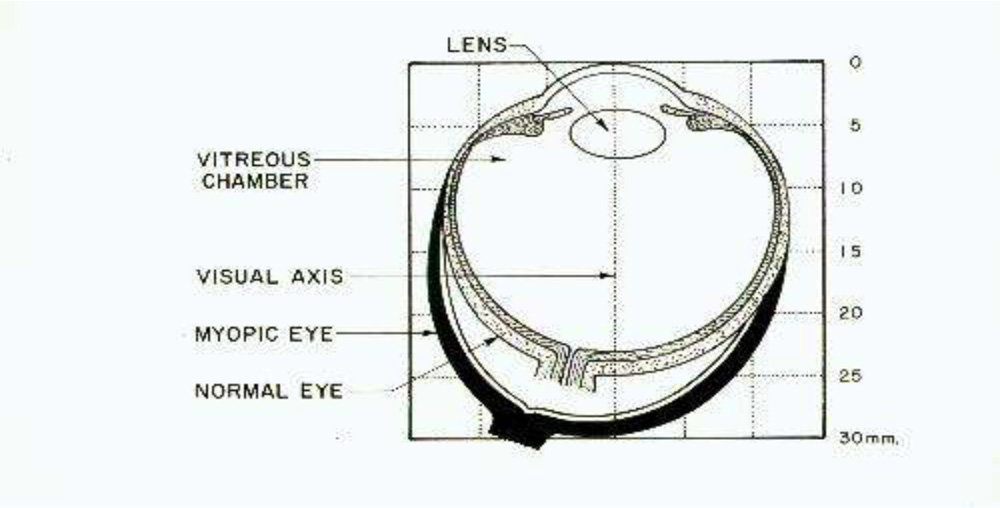
Although retinal nervefibrelayerthinning is indicativeof glaucomatous damage, it remains uncertain whether retinal nerve fibrelayer thickness would vary with the refractive status of the eye.
It is therefore important to investigate whether any correlation exists between retinal nerve fibre layer thickness and axial length in myopia.
AIMS AND OBJECTIVES
To evaluate the peripapillary retinal nerve fibre layer (RNFL) thickness by spectral domain optical coherence tomography (SD-OCT) in myopes.
Correlation of axial length and peripapillary RNFL thickness in myopes.
METHODOLOGY
180 eyes of 90 randomly selected patients were evaluated.
Patients were selected between age group of 15-40 years.
Diagnosed glaucoma cases or patients having IOP >21 mm of Hg and diagnosed neurological diseases affecting optic nerve and or RNFL were excluded.
Patients were divided into three groups acccording to myopic refractive error:
Low myopia ( -6.00 D)
Low myopia (<-3.00 D)
Moderate myopia (-3.00 to -6.00 D)
High myopia (> -6.00 D)
And Axial length
AL < 24 mm
AL 24-26 mm
AL > 26 mm
- Visual acuity was measured
- Refractive correction was done
- Best corrected visual acuity was measured
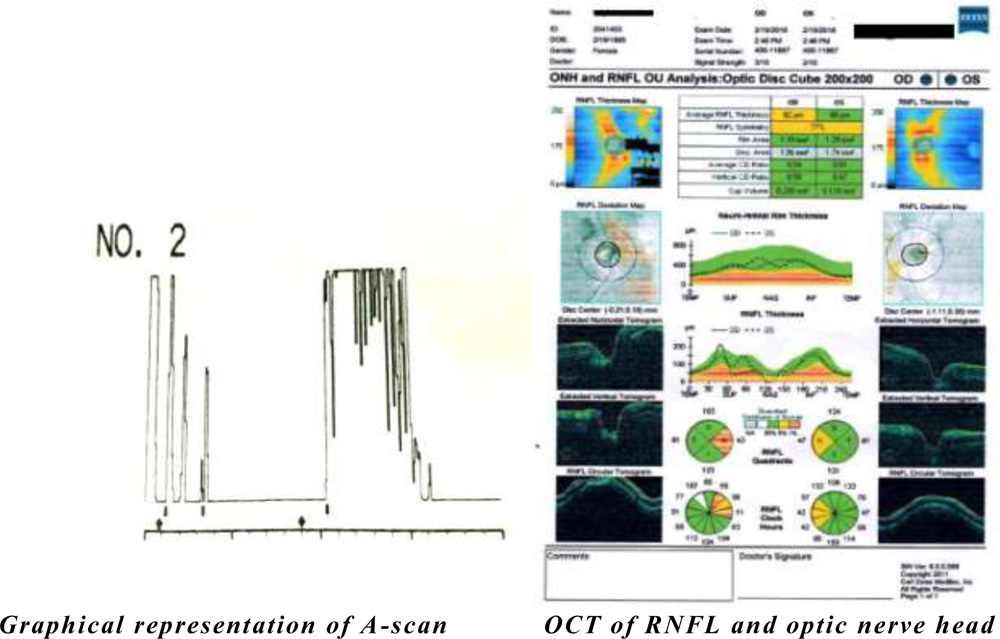
- Axial length was measured by A-scan ultrasonography
- Average 360 degree and quadrant wise RNFL thickness was measured by SD-OCT
- ‘p’ value was calculated by one way ANNOVA test and
- To analyze correlation between Axial length and RNFL thickness Pearson correlation co-efficient (r) analysis was done.
 RESULTS AND OBSERVATIONS
| Degree of myopia | No. Of eyes | Percentage (%) | Mean refractive error (D) |
| Low myopia | 95 | 52.78 | -3.52±2.40 |
| Moderate myopia | 52 | 28.89 | |
| High myopia | 33 | 18.33 | |
| Total | 180 | 100 |
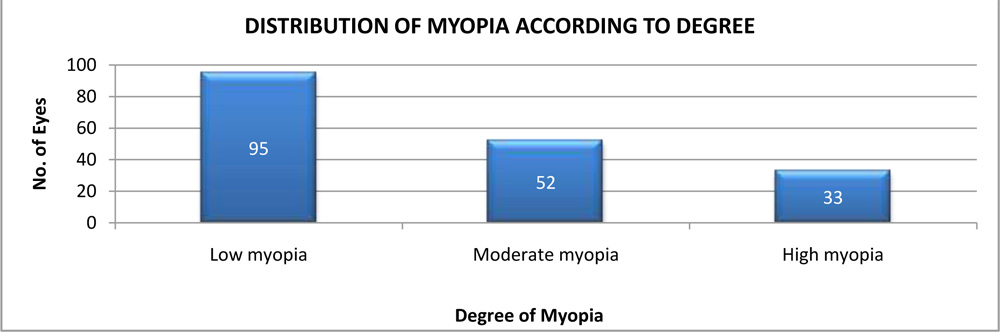
In this study total 180 eyes of 90 patients were evaluated. Low myopia was found in 95 eyes (52.78%), moderate myopia in 52 eyes (28.89%), and high myopia in 33 eyes (18.33%). So there was a preponderance of low myopia in this study group. Mean refractive error was -3.52 ± 2.40 D.
- Grouping all eyes according to axial length
| Axial Length | No. of eyes | Percentage (%) | Mean Axial length (mm) |
| <24 mm | 87 | 48.33 | 24.53±1.51 |
| 24 – 26 mm | 57 | 31.67 | |
| >26mm | 36 | 20 |
87 eyes (48.33%) were found having axial length <24 mm, 57 eyes (31.67%) having axial length between 24-26 mm and 36 eyes (20%) found to have axial length more than 26 mm. Mean Axial length was 24.53 ± 1.51 mm. (mean±SD).
 3. Average 360 degree and quadrant wise mean RNFL thickness measurement in different degree of myopia
Quadrant RNFL thickness (µm)
Low myopia Moderate myopia High myopia
| Quadrant | RNFL thickness (µm) | ||
| Low myopia | Moderate myopia | High myopia | |
| Average 360 degree | 99.72 ±5.80 | 89.04±5.33 | 77.97±7.13 |
| Superior | 125.17±10.30 | 110.01±8.71 | 95.06±11.02 |
| Inferior | 130.38±9.82 | 116.40±10.33 | 100.24±11.24 |
| Nasal | 70.37±6.65 | 60.096±6.47 | 51.70±4.83 |
| Temporal | 72.95±4.34 | 69.56±4.80 | 64.88±6.16 |
Average 360 degree and quadrant wise mean RNFL thickness decreased with increase in degree of myopia. But decrease of RNFL in temporal quadrant was less than other quadrants.
There was a significant association between thinning of averge 360 degree and quadrant wise RNFL thickness with increasing degree of myopia (p < 0.0001).
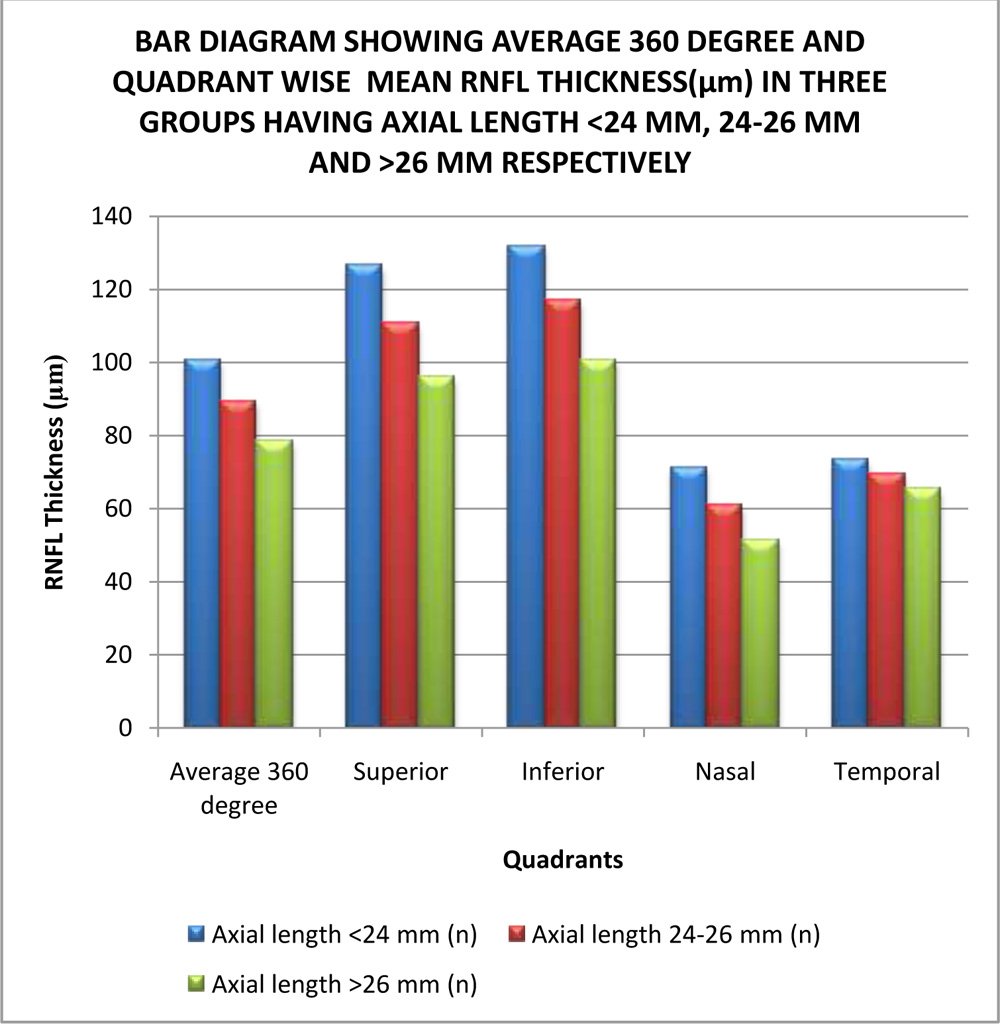
 4. Average 360 degree and quadrant wise mean RNFL thicknesss measurement of subgroups classified on axial length
| Quadrant | RNFL thickness (µm) | ||
| Axial length<24 mm | Axial lengh24-26 mm | Axial length >26 mm | |
| Average 360 degree | 100.72±5.01 | 89.40±4.69 | 78.28±6.92 |
| Superior | 126.44±9.81 | 110.51±8.32 | 95.94±10.91 |
| Inferior | 131.82±8.97 | 116.736±9.32 | 100.24±11.24 |
| Nasal | 71.23±5.38 | 60.67±6.04 | 51.22±4.86 |
| Temporal | 73.18±4.67 | 69.68±4.05 | 65.25±6.25 |
Average 360 degree and quadrant wise mean RNFL thickness decreased with increase in axial length in myopic eyes. But decrease of RNFL in temporal quadrant is less than other quadrants.
There was a significant association between thinning of averge 360 degree and quadrant wise RNFL thickness with increase in axial length (p < 0.0001).
 5. Pearson correlation analyses between retinal nerve fibre layer thickness and axial length in total sample
|
RNFL thickness |
Axial length | |
| R | P | |
| Average 360 degree | -0.935 | <0.0001 |
| Superior | -0.874 | <0.0001 |
| Inferior | -0.868 | <0.0001 |
| Nasal | -0.842 | <0.0001 |
| Temporal | -0.607 | <0.0001 |
Significant negative correlation was found between the axial length and average 360 degree mean retinal nerve fiber layer thicknes (r=-0.9348, p < 0.0001).
Analysis at individual quadrants of retinal nerve fiber layer thickness showed that each quadrant had significant negative correlation with the axial length i.e. correlation between the axial length and superior RNFL thickness was – 0.874 (p < 0.0001), correlation between the axial length and inferior RNFL thickness was –0.868 (p < 0.0001), correlation between the axial length and nasal RNFL thickness was – 0.842 (p < 0.0001), and the correlation between the axial length and inferior RNFL thickness was – 0.607 (p < 0.0001).
CONCLUSION
In our presentstudyweevaluatedperipapillary RNFL thickness in myopic eyes and found a decrease in RNFL thickness with increase in myopic refractive error.
Peripapillary RNFL thicknesses in average 360 degree and in all four quadrants were also found to be decreased with increase in axial length in myopic eyes.
So, we conclude that in our study we found a negative correlation between axial length and peripapillary RNFL thickness in myopia.
Thinning of RNFL is a good indicator of glaucoma and it also occurs in myopic eyes. So, measurement of RNFL thickness without knowing the refractive status can lead to misdiagnosis of glaucoma.