

Dr. Santosh Agrawal, A05211,
Dr. Santosh Agrawal
AUTOMATED PULSED DELIVRY OF OVD’S FOR SAFE PHACO- A INNOVATIVE TECHNIQUE
SANTOSH AGRAWAL
AURANGABAD, MAHARASHTRA, INDIA
Introduction : –
OVD’s have become indispensable tools in protecting corneal endothelium & maintaining adequate space for difficult & delicate intraocular manipulations. No single OVD is ideal to do all the desirable tasks. Hence cohesive & dispersive OVD’s are used in combination many a times to have ideal surgical enviornment to preclude damage. Still it is noted that repeated injection of OVD’s are required at different stages of surgery through main incision which spend a lot of time enormous amount of OVD’s & many sustain inadvertant damage to intraocular structures while both hands are engaged during phacoemulcification.
The new technique has been introduced in order to have pulsed inoculation of OVD’s { Cohesive & dispersive } through specially designed AC maintainer in anterior chamber. It is automized & can be controlled by footpedal as the tubings are attached to vitrectomy port on the console & lowest cut rate was resorted to.
Aim and Objective : –
To prove safety of pulsed OVD’s in phacoemulsification through automization technique.
Material and Methods : –
- Prospective study
- Total cases = 240
- Duration of study 2010-2012
- Age Ranging from 60 to 85 yrs. – 224, Pediatric cataract – 16.
- Male – 132, Female – 108
- Type of cataract
– Gr. IV & V – 91
– Gr. II & III – 95
– Post subcap cataract – 38
– Pediatric cataract – 16
– Cases lost to follow up two weeks of surgery – 5
Material and Methods { Contd… } : –
— OVD’s – Na hyaluronate 1%, HPMC 2%, AC maintainer, Scalp vein set, Adapter, Vitrectomy Machine, Tubings, Infusion Pump { Used for silicon oil }
— AC maintainer is applied at the start to have firm eyeball imparting ease during incision.
— Tubings, infusion pump, adapter are attached sequentially & lastly to vitrectomy port on console.
— Lowest cut rate – single or about 60 is maintained.
— As soon as footpedal is depressed, the forceful air impact through tubing is transferred to the injector & visco is poured in AC in small dosages.
— In this one can ues cohensive OVD’s as per the requirement during different stages of phacoemulsification.
— If deep chamber is desired cohesive OVD is injected into AC through the above system as during CCC, chopping etc.
— For corneal endothelial protection – dispersive OVD’s injected through the same system during nucleus
Fragments extraction & other manipulation.
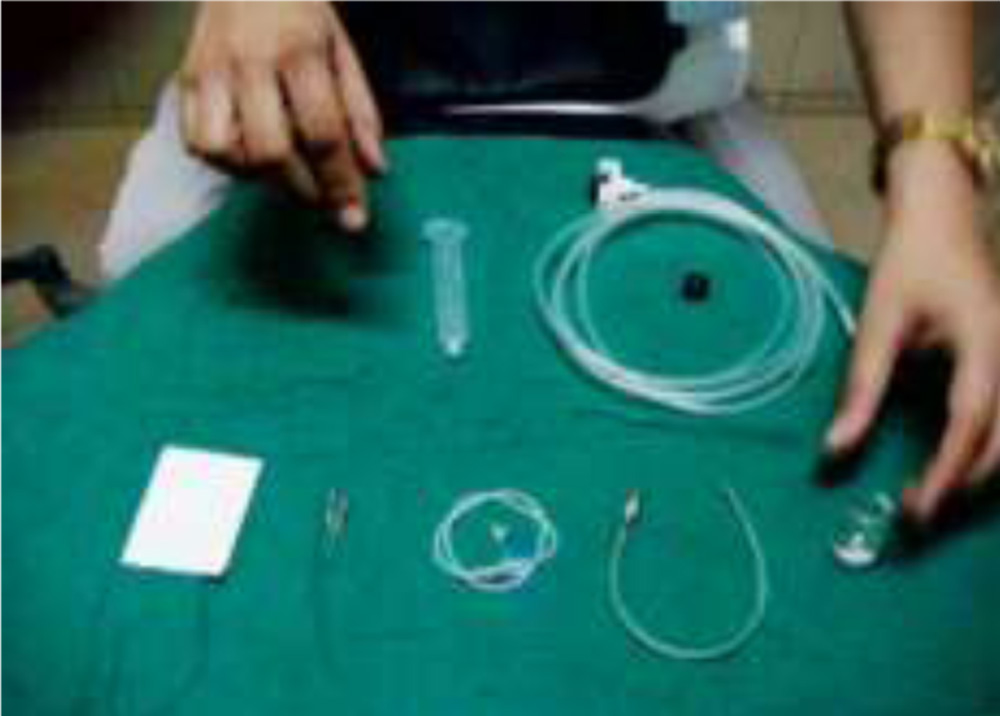
{ AC MAINTAINER, SCALP VIN SET, VISCO, STICKING, SILICON OIL INJECTION TUBING WITH PISTERN, 5ML SYRING, }
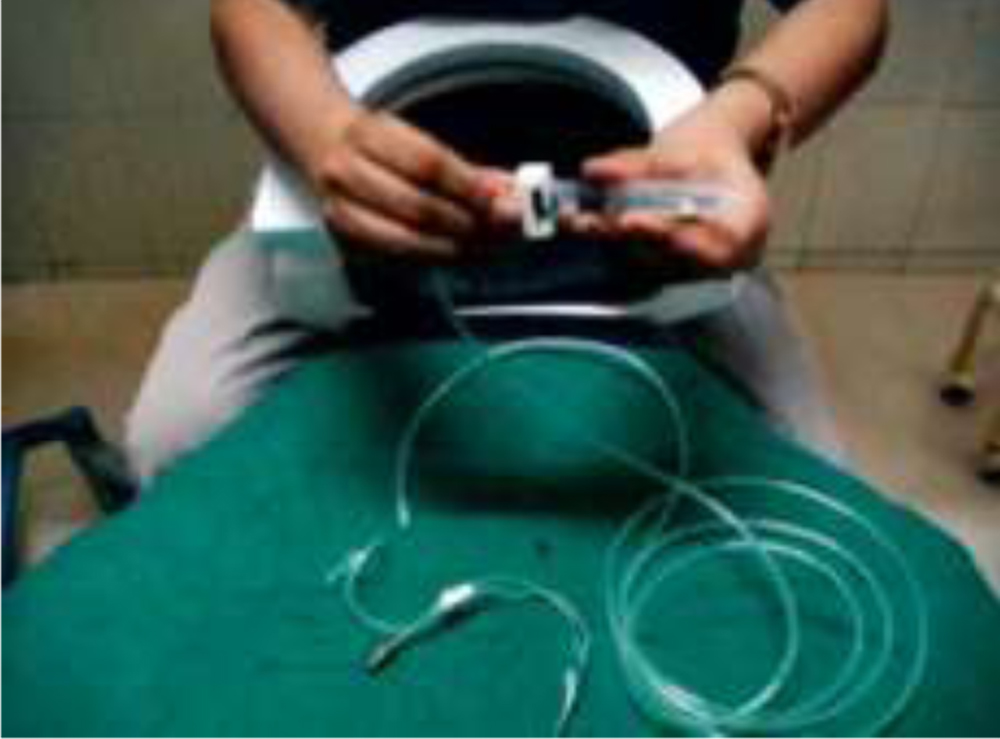
{ VISCO FILLED SYRING CONNECTED TO SOI TUBING }

{ SOI TUBING END CONNECTED TO VIT PORT }
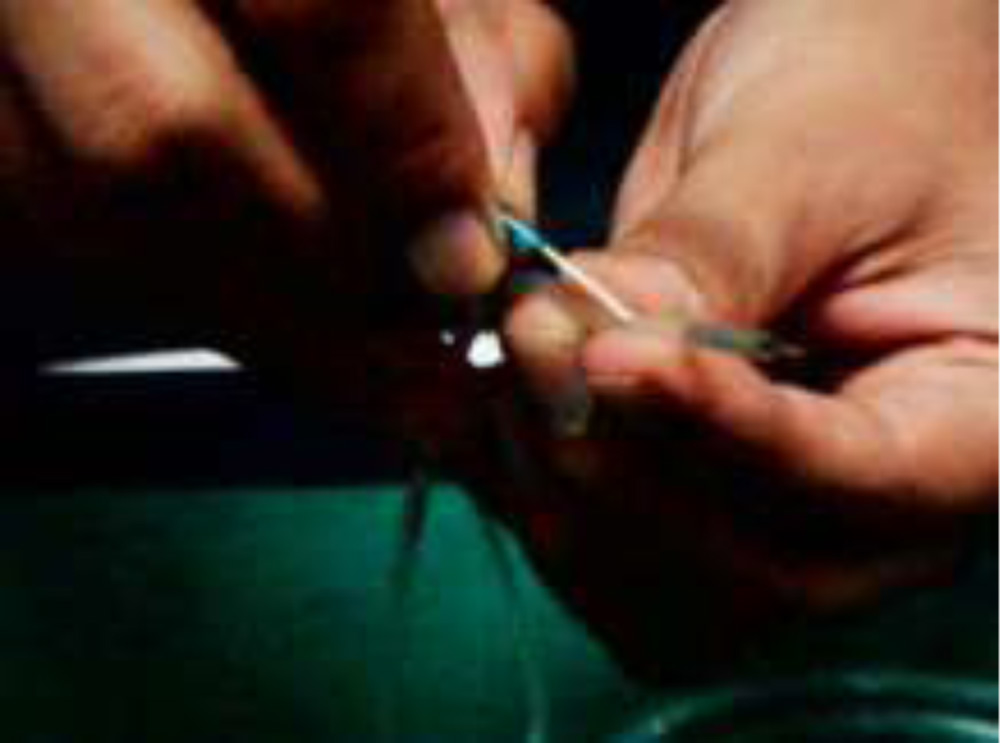
{ SCALP VIN SET TIP INSERTED IN AC MAINTAINER, ONE FOR NA HYALURONATE & OTHER FOR HPMC}
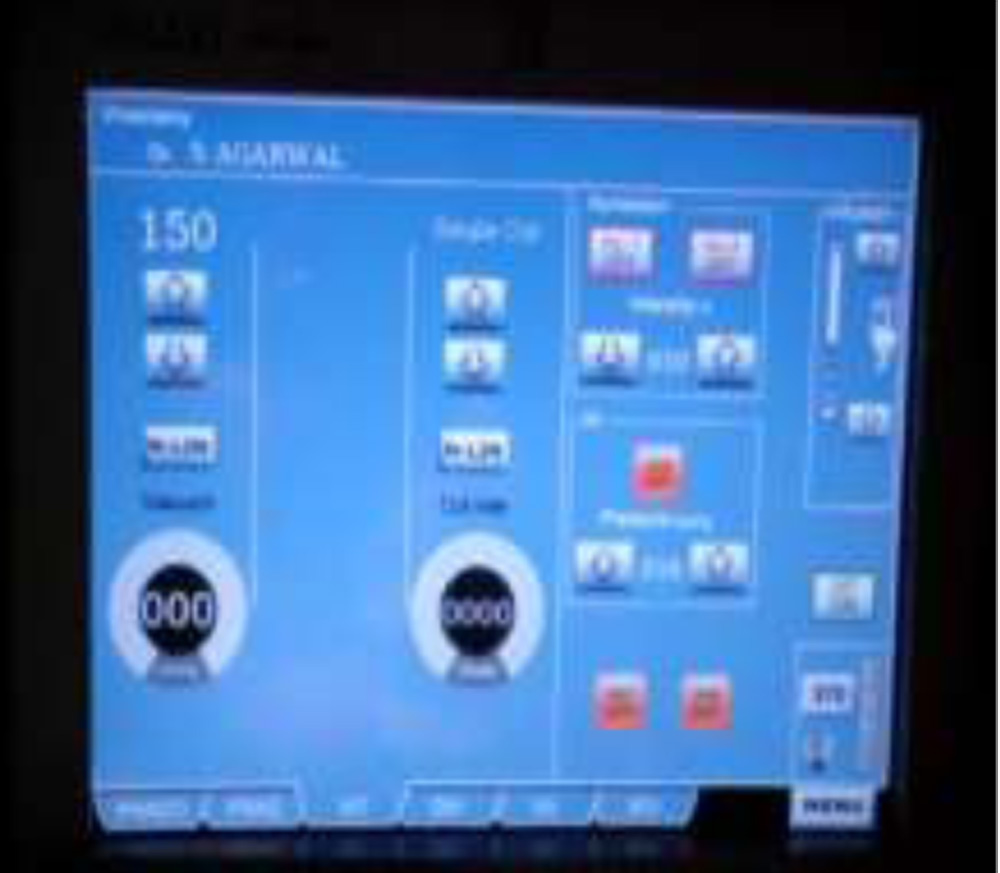 { FOOTPEDAL PRESSED TO DELIVER VISCO IN AC }
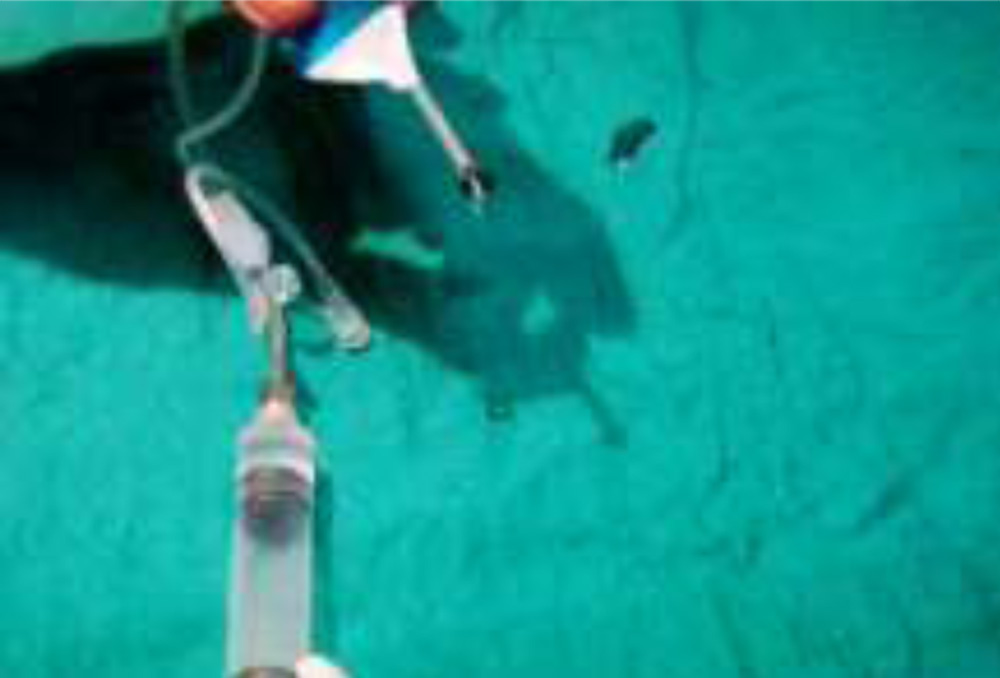
{ AUTOMATED DELIVRY OF OVDS’ AFTER PRESSING THE FOOTPEDAL }
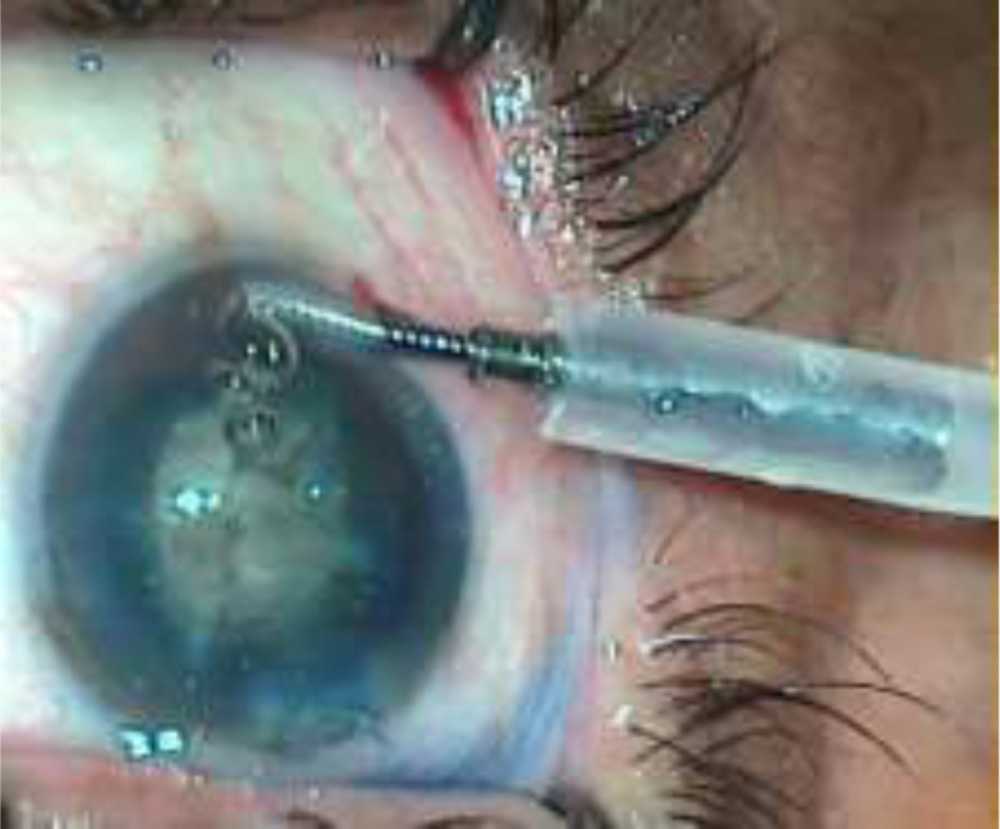
{ AUTOMATED DELIVRY OF OVDS’ DURING SURGERY}
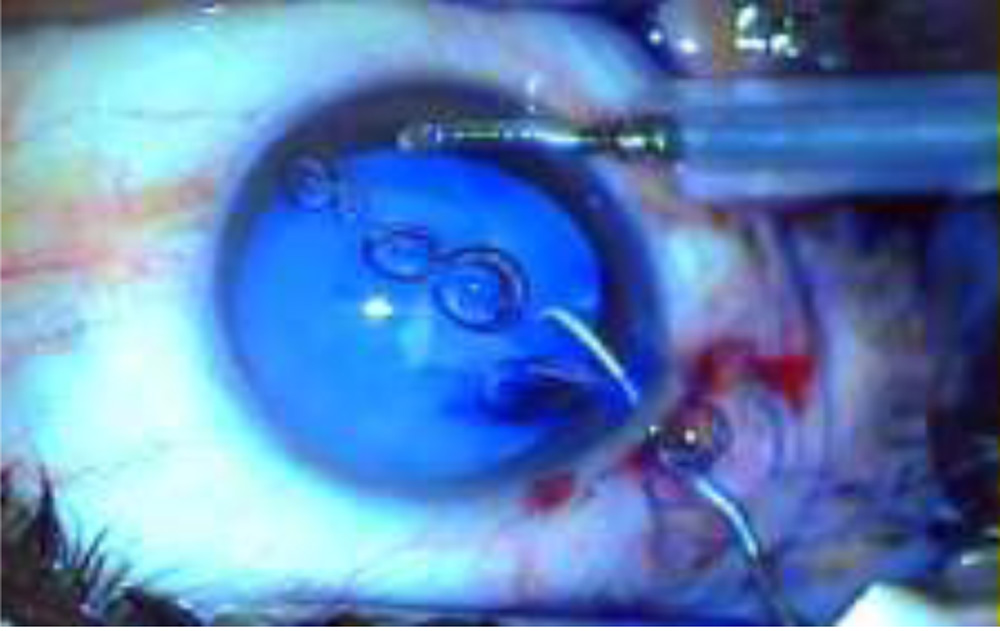
{ AUTOMATED PULSE DELIVRY OF OVD’s DURING SURGERY}
Parameters studied : –
Preoperative :-
– Corneal endothelial count & pachymetry
During Phaco :-
– CCC escape
– PC rent & vitrous loss
– Pupillary dilatation
– Trauma to different structures.
Post Phaco :-
– Corneal edema, striate keratopathy
– AC Reaction & iritis – flare & cells
– IOP
– Corneal endothelial count by specular microscope & pachymetry { At glass appointment i.e. 1 mth. }
– BCVA
Results :-
During Phacoemulsification
| Paed. Cat. | Others | |
| CCC escape | 1/16 ( 06.25% ) | 2/224 ( 0.89 % ) |
| PC Rent & vitreous loss | NIL | 2/224 ( 0.83 % ) |
Post – Phacoemulsificati
| Corneal edema / SK | 60/240 ( 25 % ) |
| Corneal endothelial loss | 05.0 % |
| Pachymetry ( at 1 mth ) | 0.3 % high |
| BCVA ( 6/18 ) | 91.4 % |
- edema, loss of endo count & PC rent were characteriscally noted in Gr IV & Gr V cases
- The ease of surgery & patient comfort were excellent.
Discussion : –
Comparison of complications during phaco
| Jeng et al | Present study | |
| CCC escape | 53.3 % 10 %
( Haelon + Viscoat ) ( Haelon 5) |
3/240 – 1.25 % |
| Fishkind et al | Saraf et al | Holz et al | Present study | |
| PC Rent & Vitreous loss | 0.8 – 1.25 % | 1.7 % | 2.0 – 5.0 % | 0.83 % |
| Bastiet al | Abrar Ali et al | Present study | |
| Corneal edema & SK | 11.6 – 59.0 % | 53.0 % | 25.0 % |
| Nayak et al | Miyata et al | Kim et al | Holz et al | Present study | |
| Corneal endothelial loss | 7.4 % | 6.4 % ( Soft shell)
16.3 % ( Healon alone ) |
12.2 % ( Viscoat + Hyal 2000)
20 %(Viscoat alone) |
6.2 % ( Healon 5)
15.4 % ( Viscoat ) |
5.0 % |
| Nayak et al | Oshika et al | Present study | |
| Pachymetry ( % Increased) | 0.51 % | 0.51 % | 0.30 % |
| Gogte et al | Present study | |
| BCVA ( 6/18 ) | 81.08 % | 91.40 % |
Excellent results can be attributed to : –
- Excellent C. endothelial protection throughout the procedure.
- Adequate space for manipulations during surgery, so least trauma & postop, inflammation (no ac collapse)
- Amazing PC protection as it is kept away from phaco tip.
- Use of cohesive & dispersive OVD’s during different stages of surgery.
Shortcoming : –
– This innovative technology still needs many more modifications to refine it & ensure technical alteration in the phaco machines.
Conclusion : –
It is indeed a revolution to have such a automated pulsed delivery of OVD’s for the great safety of phacoemulsification which have reflected in more promising & predictable outcome.